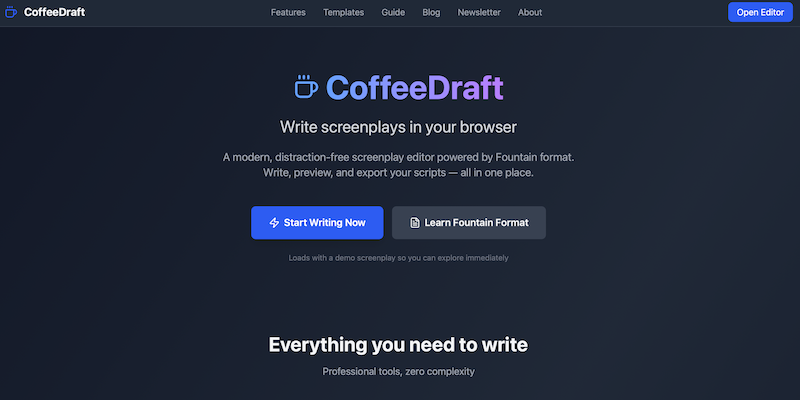
CoffeeDraft started from a simple frustration: existing screenplay tools were either expensive, required installation, or demanded account creation just to write. I wanted something that worked instantly in a browser — no signup, no subscription, no friction.
The Problem
Every screenwriting tool I tried had the same issue: they wanted something from me before I could write. Final Draft costs $250. WriterSolo wants my email. Highland is Mac-only. Most cloud tools sync your work to servers you don't control.
"The best tool is the one that gets out of your way."
I wanted to open a URL and start writing. That's it.
The Solution
CoffeeDraft uses the Fountain markup language — an open standard that turns plain text into formatted screenplays. Your work is just text. No proprietary formats, no vendor lock-in.
Everything runs locally in your browser. Your screenplay never leaves your device unless you explicitly export it. No cloud sync, no analytics on your content.
Features
- Real-time Fountain syntax highlighting and formatting
- Instant preview of your screenplay in industry-standard format
- PDF export with proper margins and pagination
- No account required — your work stays in your browser
- Works offline once loaded
Technical Approach
Building CoffeeDraft taught me how to create a modular parser from scratch. The Fountain specification has edge cases that most editors get wrong — dual dialogue, centered text, lyrics — and getting these right required deep understanding of both the format and how screenwriters actually work.
The parser architecture is modular, which means it can be extended for other markup languages. This is exactly what I'm doing with CaveDraft for interactive fiction.
CoffeeDraft stores data in localStorage. Clearing your browser data will remove your saved work. Export your screenplay regularly!
What's Next
CoffeeDraft is complete and stable, but I'm considering a few additions:
- Multiple screenplay tabs
- Custom PDF styling options
- Fountain syntax reference panel
This project proved that browser-based tools can be just as capable as desktop software — and more private. The constraint of "no backend" forced better design decisions.